Bundi

The city, which is not really on the tourist route, has a population of about 100k. It has 54 stepwells, steps that lead down and down and down to a well; we visited the largest, which has a depth of 53 metres. They used to be the source of all water in the city, but have been superceded by mains supply. Apparently, their efficacy is all about the groundwater status which is reducing as the population is increasing.

Then a visit to the hill-bound palace, last occupied in 1950. Some of the wall paintings, 400 years old, are exquisite. The hotel is another mansion house converted into an hotel. This one has a luxurious courtyard. Architecture wins, but the constricted noisy streets don’t make this a favourite place; Kath, however, loves the market.

Train at 8pm to catch the sleeper to Mumbai.

Mumbai

Udaipur – last day

Collected this afternoon the white linen jacket I ordered yesterday. Tailor made. Wow.

Leaving at 5pm for the train to Bundi, eta 10.30pm. The journey is on a sleeper train, so a dry run for tomorrow night’s overnighter to Mumbai.

Our holiday is half done, half to do. Seems like we have been on the (rail)road for a long time. Good time to consider the contradictions that seem to typify India:-

Queues – as previously stated, they have to form queues to buy tickets, enter metro stations and attractions, etc., but as soon as they can they dispense with the concept, so kiosks, ATMs, shops, traffic, all ok for charging into bedlam, pushing, shoving, all acceptable it seems.

Red tape – as with queues, there is an inundation of form filling and ticking, with train guards, hotel room, customs on arrival in the country (despite having an entry visa, you still have to fill out an entry form handed out on the aeroplane); yet as soon as there are no officials everything seems to go. There are loads of police yet they seem to do nothing. In fact, there are loads of people employed, as previously mentioned, yet their efficiency is diluted by having so many people with not enough to do. As with Panama, perhaps it is a political strategy that huge numbers are employed, thereby reducing the numbers of disengaged and economically inactive. Perhaps …..

Traffic – as above, their use of roads is quite simply the worst I’ve ever seen. Yesterday we witnessed the town centre of Udaipur gridlocked. And as soon as a chink of space was created by movement of one front it was filled by every vehicle from another front just piling into it. Even walking along the side of the road, lane, alley, pavement, is taking your life into their hands. Astonishing there aren’t more accidents. Noticeable that extra bumpers are fitted to many cars, though we’ve yet to find any without traffic scars.

Roundabouts – worthy of special mention. Just because there is an island in the middle of the road does not prevent vehicles from using any way round. Just not ‘around’.

Politeness – one minute they’re the friendliest, the next they’ve barged you out the way as they charge into the metro before you can get off. Any effort to engage your attention seems to be part one of their sales manual – heck, it’s part one of every sales manual – but in every city centre everyone seems to be a practitioner.

Patience – you have to wait ages for your food order to arrive, yet as soon as it’s finished it’s been cleared away, regardless of the eating progress of those on your table. In fairness, most of the meals we’ve had are freshly cooked and well worth the wait.

Menus – as above, their food is mostly fantastic but often the choice is but a smidge of what is on the menu; the drinks menu is even less of a guide.

Bundi

Udaipur

Another 5am start to catch a train to Udaipur, some 7.5 hours away. And another opportunity to watch a red ball appear at the edge of the sky and turn into a yellow sun, all within about five minutes. Glorious.

These train journeys are great fun. Almost every seat is booked and the travellers board by up to 30 minutes before the train leaves, unless of course the start point is after the train’s. This seems to be about storing your luggage near to your seat, as opposed to further down the car. The trains are a mixture of pretty smart to most things not working, but we’re not travelling in the third class areas which look most uninviting. A chi walla walks up & down the train; you can buy a small paper cup of pre-sugared chi for 10 rupees, about 11p, and after the induction period it’s …….. ok. Then there’s a guy selling omelettes, another yesterday selling Dominoe’s pizzas, and we are still to travel on an overnight train; that I’m sure that will introduce a new range of vendors. But we’ve yet to see passengers hanging onto roofs or windows, though we have seen monkeys so performing ‘in station’.

Udaipur is located on Lake Pichola, so has a bit of a resort feel. However, with a population of about 450k, this is another multi-traffic-charged complex of narrow roads, lanes and ways narrower still. After yesterday’s town introduction, we went to a “traditional folk music” performance and the dancing and singing were fine. The show stopper was at the end when a 70 year old lady balanced up to 12 dishes on her head and still managed to dance. The crowd went ballistic.

So that was yesterday. Today a visit to The City Temple, complete with chanting Hindus, and then The City Palace. The Palace is the biggest in Rajasthan, second biggest in India and is HUGE. It includes three hotels and a conference centre, which, together with seven other hotels in Rajasthan, enables the owners, The Maharana and his family, to give the entrance ticket fees to charity. The Palace has a number of internal squares and many narrow passageways and has a special ambience. Our favourite Indian palace so far.

We’re here for two nights and (most of) three days, so some time to feel a little settled. Kath has discovered painting workshops (this afternoon) and cooking classes (tomorrow morning). I have visited the Maharanas’ car collection. It seems every time they bought a new car they hung on to the previous one as well, hence a collection of Mercs, Rollers (one used in a James Bond movie), Moggies, a Cadillac, a Buick and some jeeps. Was stylish.

We’re taking an evening boat trip on the lake to watch the sunset and then to another, outside, restaurant, constantly led on by Prado, our tour guide. He’s quite shy but we’ll organised and agile. One of our party has departed for Mumbai today, three days early, to attempt a passport replacement – she lost the original yesterday. We’re impressed with Prado.

Udaipur – last day

Jaipur

Another fraught traffic city, Jaipur does have some cultural feel beyond its most famous attractions, namely the huge hill bound fort, complete with the world’s third longest walled defence system and its charming water palace. It also has a more vibrant economic offer, with famous market and high street offers. In addition, it has an extension to its metro system being built, which of course adds to the turbulent traffic of its centre. The city was created as the old version at Amer was outgrown and its 18th century stab at town planning provided a neatly arranged road system within a crenellated outer wall, with all walls being painted pink. Any alteration has to comply with this colour code, hence the ‘pink city’ renown.

We’re staying in a former Rajistan palace – there are more than a few around of which many have been converted into hotels and restaurants – the Hotel Bissau Palace. Resplendent in its architecture and hand painted walls with hunting and floral scenes. Not so with its apparently typical faulty, fire threatening electrics, damaged unfittings and unfixtures and general lack of TLC. It does feature, however, a period dressed walla (as in chai), much in the vein of the Julie Walters role in Acorn Antiques.

Tuesday morning begins with a 5.30am departure on a minibus, with two others from our party and five from another G-Adventures group elsewhere in town, for a balloon ride. A particular Kath request, this was a genuinely surreal experience, crossing a verdant valley just 100 feet or so above its inhabitants, wishing then a good morning amid mutual waves. The only noise the occasional burning of the gas jets. After about 45 minutes a touch down and all safely returned to their hotels. The pilot was a charming professional air balloon pilot from Turkey, with three months spent in Jaipur, three in the Masai Mara, then we didn’t get to find out where. How about that for a career aspiration, said Kath. Noone felt able to comment.

Then to meet up with the rest of our group at the Amber Fort and another gorgeous (City) palace within the fort featuring the third longest defence wall in the world. Very sad to watch convoys of elephants taking visitors up to the main entrance, as the huge animals seemed so sad despite the colours added to their faces. A bit clown like.

Another fine (help yourself this time) lunch prefaced a visit to a craft and materials showroom. Unfortunately, the silks, saris and other fine work twanged the females’ aspirations; we all left heavier in belongings, lighter in bank balances.

Next a visit to Jantar Mantar, one of the five Indian observatories, constructed in the early 18th century. It looks like a giant playground for monkeys but on closer inspection the huge edifices and wheels reveal a keen scientific grasp of measuring astrological and temporal matters. Our guide was proficient at telling the time – we tested him three times.

Udaipur

World Wonder

With great delight I can inform you the Taj Mahal really is astonishing. It is massive, of white marble and bejewelled, absolutely symmetrical and heaving with visitors. As with all visitor attractions we have so far seen, the vast majority of their customers are Indian. Such is the size now of the Indian population: 1.25 billion. And growing at the rate of over 12 milion per annum.

We visited the Taj early, a good idea. As we left, the queues were considerable. Apparently, there are 20k every day, with up to 50k in the summer. Except for Fridays, when it’s closed. Other than for visitors to the mosque. The Taj is actually a mausoleum. Built by the third Moghul Emperor for his beloved late wife. The building has not been truly symmetrical since his coffin was laid by the side of his wife – he was taller.

Post another delicious curry lunch stop, a visit to India’s second biggest fort. The double walled effort of Agra is huge; it lies on the side of a significant hill with a curved entrance between the outer and inner walls – this is to stop charging elephants headbutting both entrances down. Inside there is less now than once was as the Indian Army has claimed 75% of the former footprint for operational and administration purposes; if the efficiency approach was applied, as per previous comments, perhaps the fort could have 75% of its original footprint.

Off then to catch the 2.45 train to Jaipur.

Jaipur

Adjusting to Delhi

Yesterday was Lodi Gardens, with ancient unused mosques, thousands of screaming schoolchildren, chipmunks galore and a gallery of fat geese. On our way there we passed the entrance to Claridges Hotel, its security included a boot and under the car check. We also visited Raj Ghat, where Gandhi was cremated, and Safdarjang’s Tomb, with a grand mosque, unused, and two Taj Mahal style pools, one at each end. Finally, a visit to The Lotus Temple, one of Delhi’s latest holy buildings and completed in 1986. Another queue to gain entrance, but this is a truly beautiful building, a temple for the Baha’i.

A beer turned into a meal at Unplugged, a venue known for its musical performances, not for the drink or food. That was our last visit to Connacht Square, a circle really. Built by Edward Lutyens in the early 20th Century to celebrate the British Empire. This is the centre of New Delhi, the capital of India, as opposed to the rest of Delhi that is Old Delhi and lies all around the new part. A last gin in The Crossroads Inn, at the corner of our hotel’s street, because, well you’d have to, wouldn’t you.

Today was Republic Day, which meant much quieter traffic this morning. We visited the Garden of Five Senses, with metal, stone and ceramic sculptures and hundreds of very young no touch canoodlers. Before we left we tasted a vegetarian curry platter for two – superb. Returned via a long walk in a scrappy wood in Hauz Khas (pronounced Hoyse Karz), which if we’d found the right bit would have felt a like Hampstead market on a weekend, apparently.

Met the group on our tour this evening – fascinating mix of Canadians, USAians, Brits and, mostly, Australians. Apart from our charming guide, Prado, there’s just two blokes, incl me, and 12 females. Going to be tough.

Toughest was the non-alcoholicness of Republic Day. Thankfully, despite a 5am departure for the train to Agra, home of the Taj, tomorrow reverts to normal service.

So what are our thoughts so far on India? Huge vultures flying overhead, not unlike Panama City. Hordes of underused staff, everywhere, do not make for efficiency, or even particularly good service. Queueing is required for so many entry points, eg transport and attractions, yet the locals are pushing, shoving, bargeing to get past you whenever they can; for that they are impolite. Beneath that, they are actually charming and delighted to impart their local knowledge to assist you.

The metro is superb, the vehicle wars on the roads carnage; except they don’t seem to have that many accidents. And when there is huge demand for the metro, there is still just one security clearance entry, so that the queue goes down to the street, round the corner and on and on. They’re not the best at marketing themselves. Although they do wear, turbans and clothes, the most brilliant colours.

And perhaps the least expected, everyone stares at Kath. The school kids ask for selfies with her, she must have completed at least 20, some with as many as six kids in the photo. Even the adults stare. They are not used to seeing non-Indians, obviously, but white haired people, what is going on?

World Wonder

India – 2019

23rd January

After a snow-heavy drive for the last hour, we arrived at a huge (800 bedrooms) Holiday Inn at Heathrow. The snow continued to the point we were mighty relieved at 5.20 the next morning we were only a short hopper drive away from Heathrow’s T2.

Smooth flight delivered us to a smog choked Delhi and car jammed roads, even at 11.30 pm on a Wednesday. Compensation was our delightful female driver – the travel agents use “Women on Wheels” for their airport taxi pick-ups etc, a charity set up to encourage women to stand up to the traditional Indian inferior female roles. Not only was she super friendly but also a great driver amidst the seemingly imminent crash environment. She even cut up a police car with flashing lights!

Tomorrow will reveal (or not) the infamous smog and nitrous oxide skyline and fumes of this huge city. Its population is currently an estimated 18.6 million, nope change that to 25 million (Lonely Planet). It includes at least four former cities, as each new ruler has stamped his city footprint. And a gleaming metro system to outshine the tuk tuks, cycle rickshaws, motorbikes and scooters, not to mention cars, vans, buses, coaches and lorries, all hell bent on watching the front of their vehicles and ignoring the rear, Hyde Park corner style driving ad extremens.

And Thursday turned out to be sunny, at least until about 4pm when rain showers visited. We have walked, metroed (£5 for a three day tourist card), tuk tukd x3 for an exhausting day. Much of the area beside the river Yamuna is seriously fenced off for the next four days in readiness of the India Day march on 26th January. Prime Minister Modi entertains Jacob Zuma, South Africa’s President, whilst the Indian armed forces apparently parade for only a ticketed audience. And to gain a ticket you have to be an invited VIP or a local resident. So we saw nothing other than the distant outside of The Red Fort, The India Gate and various other famed buildings. We did see the house of Mahatma Ghandi and that of Indira Ghandi and her son Ranjiv Ghandi, all assassinated last century (I remember, but some of our readers I suspect will not).

There are many police, it seems, everywhere, with fierce weaponry, and serious body and bag searches before you can enter the museums and even the metro. And we have been warned many times already about hanging on to bags, phones, etc. to prevent their theft; we’ve not been here 24 hours ….. This city is full of risk takers.

It is also full of sales people. If some of our forays to Turkey, Tunisia, Morocco, Kenya et al have felt oppressive because it seems all are hawking their wares all the time and everywhere, they’ve just been our learning. This class-ridden country has its capital city proving its class system extends to its hawkers. Beggars in the street – men, women and children, many with limbs missing or other disatbilities – up to too persistent haughty shop keepers, all are ‘on the make’, as in doing their utmost to let you part with some of your cash.

And then you see an elephant laden with cut branches, crossing a frantic traffic junction; monkeys chasing each other over tarpaulin or plastic market stall roofs and chipmunks darting up trees, bushes and walls next to the chock-a-block highways. A city of contrasts.

First curry today, recommended by the most persistent of our tuk tuk drivers; just excellent, every single part, in a restaurant outside the Khan Market, Delhi’s foodies’ favourite, apparently.

Adjusting to Delhi

Leeds and out

Two nights in Leeds enabled us to spend a delightful three hours in Yorkshire Sculpture Park, replete with over 80 sculptures in a large open parkland setting, with a bonus two covered exhibition halls. We both loved all of that.

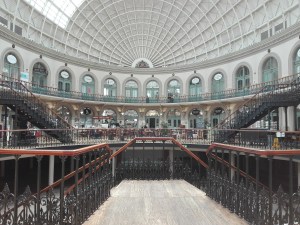
One day chilling amidst the beautiful Leeds city centre arcades, the restored Corn Exchange,and a new favourite cinema, The Everyman, above the Trinity Shopping Centre, where you can have trendy food or drinks and then choose between armed chairs, armchairs or settees to watch the film. The film, true to our holiday series, was s**t: The Book Club. Just don’t.

And then, today, on our way home, we visited last year’s museum of the year, The Hepworth Gallery, in Wakefield. HEPWORTH GALLERYA David Chipperfield designed, concrete walled building did nothing for us. Until we went in and then as little as we liked the exterior, so much did we love the interior, with many Henry Moore (who came from down the road Castleford) and Barbara Hepworth (Wakefield born and bred) pieces.
A superb way to finish our northern road trip. Six hours later, we’re back at home. To be met with a speeding ticket from our stay at Perth. Only a little grrrr, it was a great trip.

The East Coast

The road trip down the east coast was mostly uneventful, due to not being able to see more than about 50ft ahead – the sea fog (“har” in this part of the world) persisted until mid-afternoon. We called in to see this pad on the way down.

DUNROBIN CASTLE

Dunrobin Castle belongs to the Sutherlands. We also saw another golden eagle, various falcons, an european owl; entry included a falconry display.

We stayed overnight in Elgin, not for the marbles but for the cathedral, albeit a ruin. We forgot to visit the ruin but we did see standup comedy above The Droughty Cobbler (thirsty shoemaker). We were two of 17 in the audience. They tried v hard, the headliner was ace.

Next day to Aberdeen, taking a divergent route along a “snow road” over The Caingorms, a range of mountains that includes Aviemore, home of Scottish skiing. Except it was gorgeous sunshine.

A third floor roof-spaced AirBnB is mighty fine temp home as we delve into the delights of city culture. Saw Edie at an upmarket film house. The film, which stars an 80 year old Sheila Hancock and was released last week, to us is bang on right now, because it is all about walking up mount Suilven and captures its stunningly beautiful Western Highlands surroundings, which we left behind only a few days ago. Otherwise, the film is eminently forgettable.

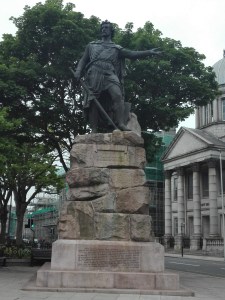
The beer choice is the opposite, this being the home of Brewdog and host to many others. And the chappie below, aka William Wallace. Not a hint of blue on him. Or Australian.

WILLIAM WALLACE

Aberdeen

At the end of the island

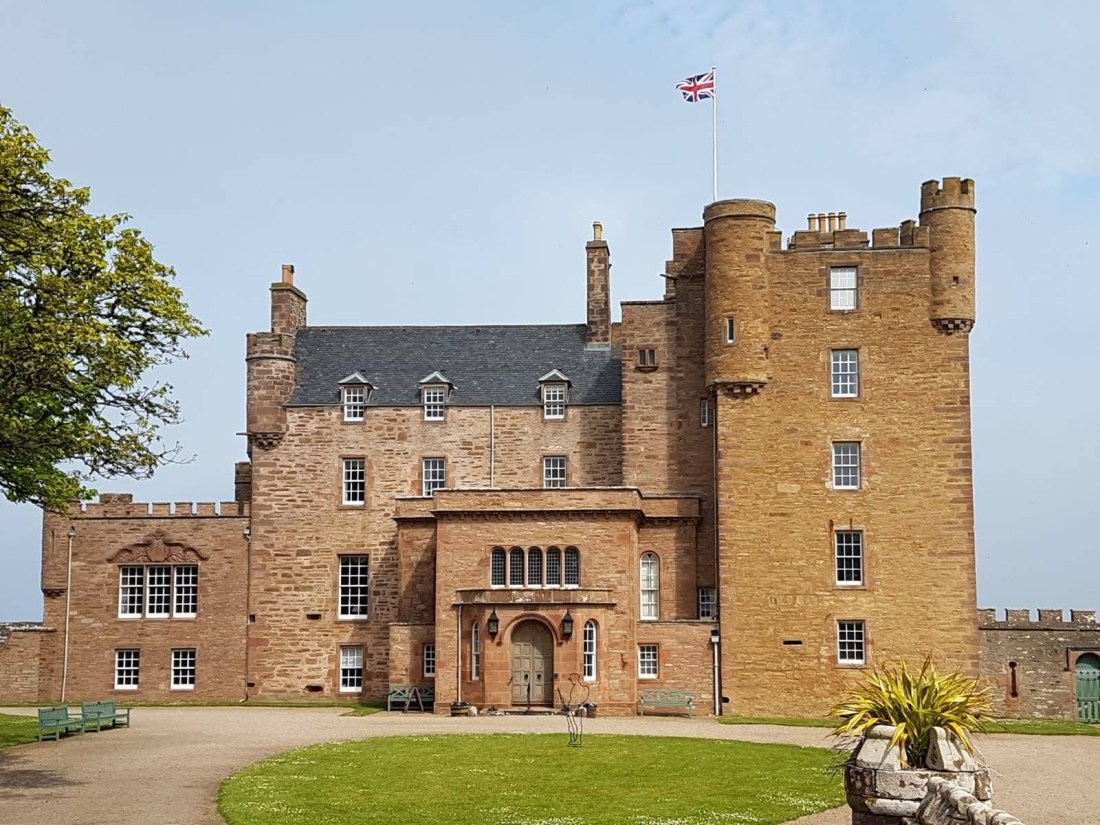
On the way to John O’Groats we stopped off at Castle of Mey (pronounced Meh). IMG-20180529-WA0001The Queen Mother bought it as a pile of stones in 1952, as a way of getting over losing her hubby. She paid £100 and then spent her own money on doing a ”Phoenix”. As castles go, it is small and intimate, and apparently even at the age of 101 she was skipping up and down the stone staircases. She left it to a new purpose built trust. So, Uncle Meh, it might be difficult to take ownership.

Next was John O’Groats, not nearly as tacky as some would have you believe. Best was the fog, so we could see nothing of The Orkneys, just eight miles away. But we could see the breakdown of stereotypes, as visitors from all over the world helped take snapshots of each other in front of the signpost. JOHN O'GROATSThis included Asian families of four, with all three females mostly obscured by hoods, taking photos of a group of four aged Hell’s Angels with the brightest, whitest motorcycle boots you ever did see; a just arrived, ever so excited single cyclist kit in all the lycra etc, and cyclist shoes so he could hardly walk, having his photo taken by a fat father of one child and three ankle snapping doglets; three motorcyclists taking photos of their motorcycles, without riders. A gentle, incessant stream of selfies interspersed with the extra cameramen made for a highly entertaining hour.

Then on to Wick, a sad tale of a town with millions currently being spent on regenerating the three harbours. Why three you clamour: from the 1890s to about 1950, Wick was the principal base for herring fishing in the …… world. Yep, world. At its prime, it had 1,100 trawlers operating out of its harbours, with over 3,000 land support gutters, packers and shippers.

Inevitably, the herring stock was decimated and what was left moved north, to Icelandic waters. Shame we didn’t start taking account of responsible fishing practice back then. The best part of Wick is now the fabulous Wick Heritage Museum, which tells the story of its herring rise and fall; the pinnacle of the exhibition is The Johnston Collection, three generations of family photographers whose output is so atmospheric. Yep, who’s in the museum business now …..

The East Coast