A six hour train journey, that took over seven, sees our return to Kochi for one night. Our (new) driver isn’t there to meet us, so we take another “auto” to our hotel, to find out we’ve been booked into the adjacent, sister hotel. No biggy. The sister has a cafe that’s open til 23.30, so we have some spicy food before going to bed. It’s midnight & we have to get up in 90 minutes to be driven to the airport to catch the 04.50 flight to Bahrain, thence to Heathrow.
Meanwhile, the errant driver – he says he was outside the other exit from the station – turned up & we persuade him we don’t need to leave before 02.00. When we reach reception the following morning, we find the receptionist, the security guard &, in his car right outside, our driver all fast asleep. But they all ‘spring to life’ on our arrival & we are on our way.
Our early morning train journey actually took 5.5 hours, so at 11.30 we were looking for the local driver who was to take us to The Ivory Coaste homestay. No sign of him & no response on his mobile, so we took another taxi to, eventually, find the small house in the village of Kizhunna, about 20 minutes out of Kannur.
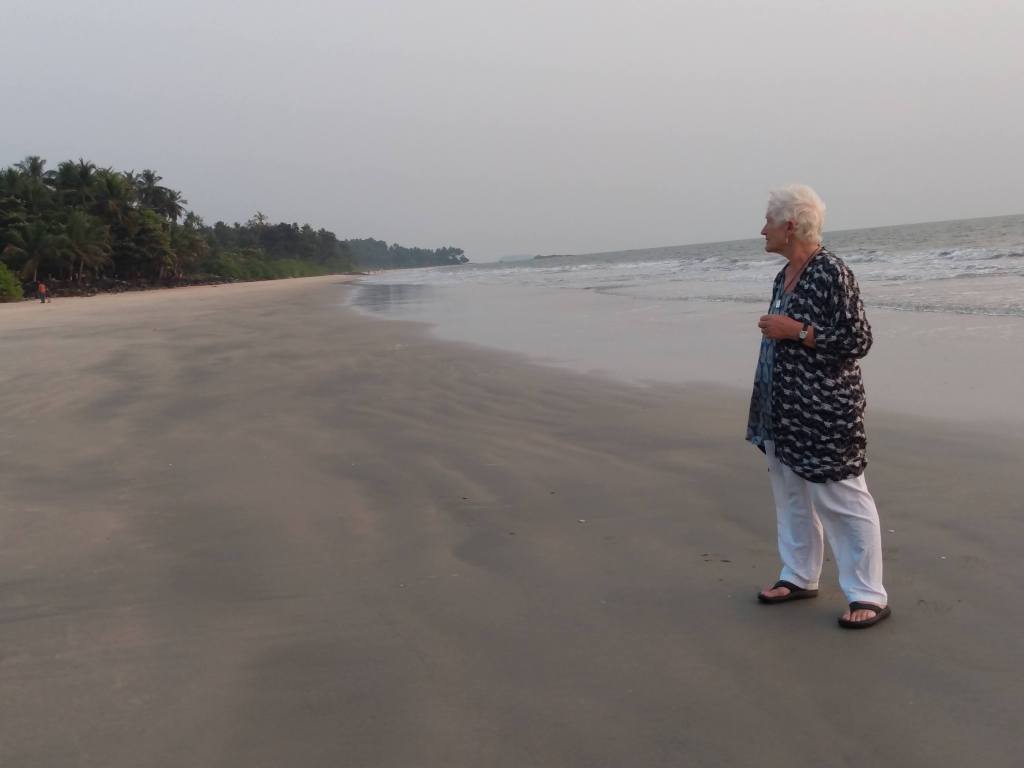
The first beach we visit is lovely, with only nine people present.
After this evening’s dinner we’re all going down to the local temple for a celebration of the gods. Chris is concerned we’ve ended up in a spiritual Ayerveda conversion trap, but nonetheless chooses to change his Tenby Brewing Co T-shirt for the temple visit. These might just be the longest five days & nights ever ….
And then Chris goes down with D&V, after a tricky morning session on the beach. Kath goes back alone to the evening performance at the village’s temple. It seems this is the temple’s last night of this annual festival, with much drumming, flinging of rice and turmeric and the final, very loud bangs at 3am, then 8am accompanied by fireworks
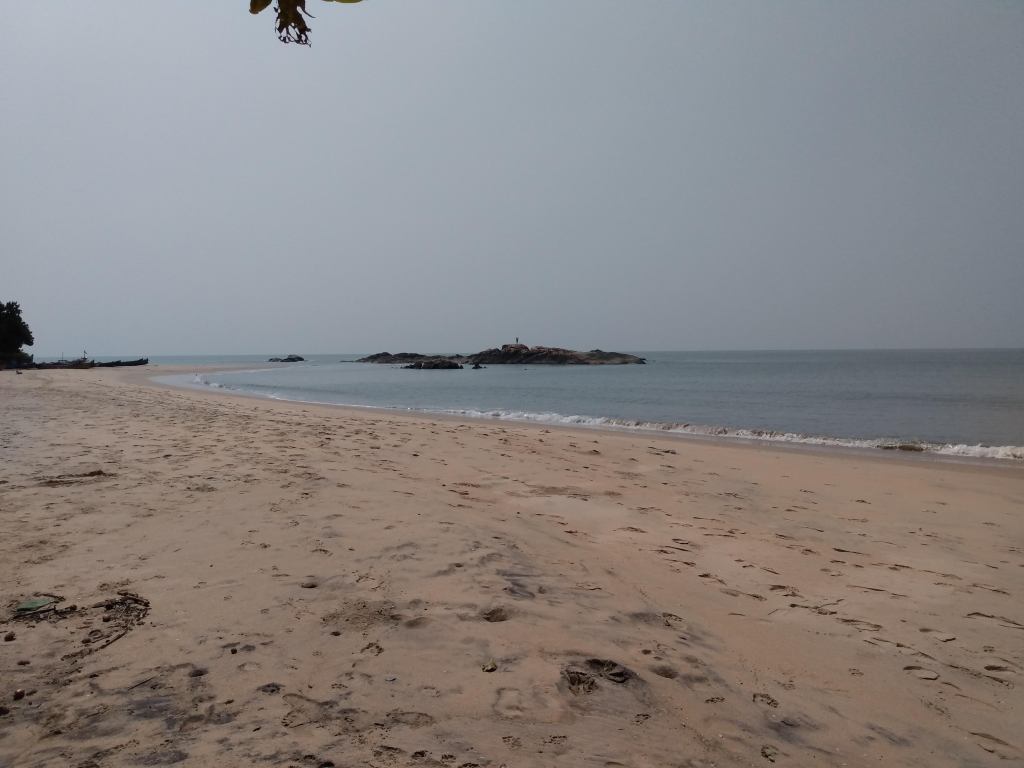
A recovery of full health means another day at the beach, but at the southern end there is some appreciated tree cover from the sun. 37to 39 degrees daytime peaks, 32 at nightime. Kath is on the rocks, as in below photo.
After the experience of two of our co-guests, we opt to visit a full Theyyam, from 3 to 7.30am. Wow, such ceremony, Carnatic music and such infinitely detailed dancing featuring three different versions of the god, Shiva, the last with flames lapping his hyper-tall headdress and circling his waist. An amazing event. Our return to quarters was at 8.15, in time for breakfast.
However, we was fired up, no time for sleep, so into the town of Kannur we tuk-tuk, ‘though in this part of India they call them “autos”, short for auto rickshaw. First a visit to the Saturday market, including a visit to one of India’s oldest shopping malls. Then a visit to a weaving factory where only 14 of the 100 looms are in use, the female weavers being paid 500 rupees for a net 7.75 hrs per day. Apparently, almost any other job pulls in at the very least double that. With robotic weaver factories expanding exponentially it looks like this industry, so long a stronghold of this country, is in dire trouble.
Then we find one of the few bars that sells beer and delight in a shared Kingfisher Strong, yet again in a dark dingy room, as if it’s not really there. A bit like travelling to another planet. And enthused by the taste we go to a government owned off-licence to buy some more, which also leaves a slightly sour taste in the mouth as these places feel like we’re in Chicago in the 30s
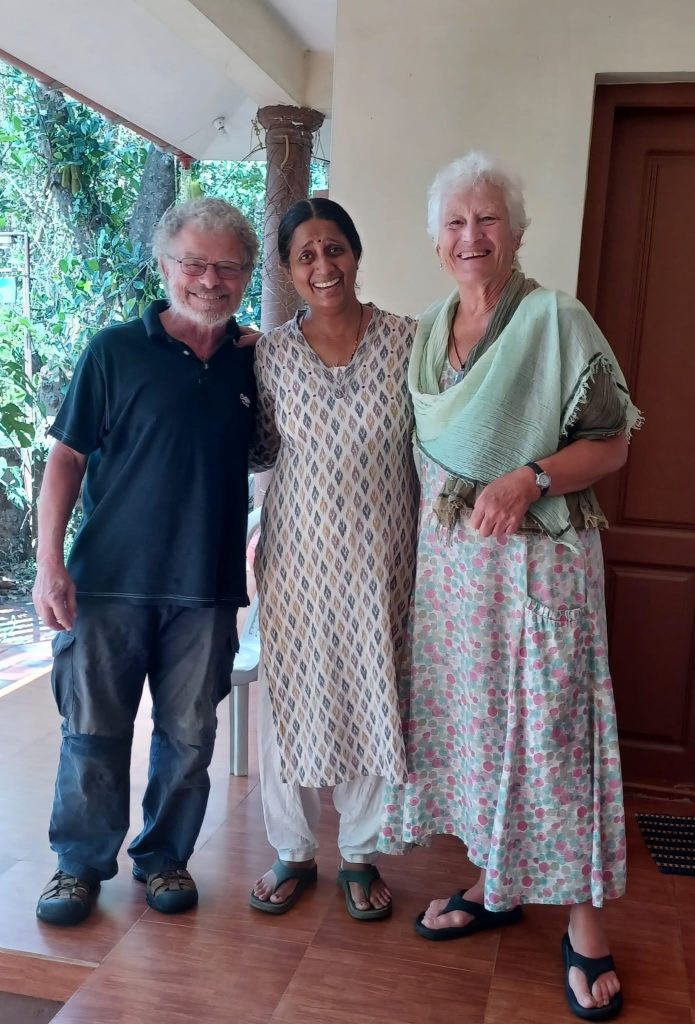
Our final day is spent on the beaches, of course, endeavouring to catch up with & invest for future SLEEP. Next morning we are saying goodbye to the owner, Apurna, & two of her longer staying guests. Quite some retreat here.
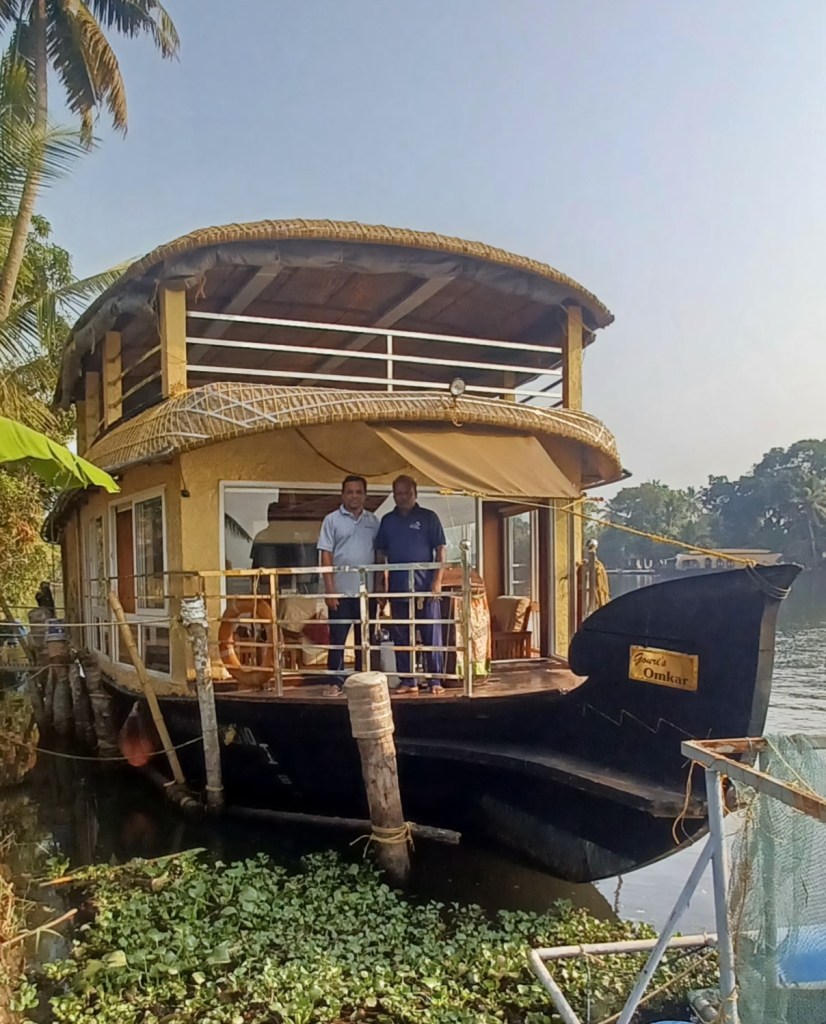
After a slight swap in the tour plan, we are delivered to a boat in Allepy on which we spend the next 18 hours: a cruise to a lunch stop, with delicious curries on board, then more cruising around the backwaters are delightful, relaxing & serene, at least until we come across bigger channels where there are hundreds of backwaters boats; we then have to get off the boat for two hours (we snuck back on after one), before being fed a delicious dinner; my call for beer is met an hour later by a tuk-tuk driver; and then we retire at about 10pm so the captain & chef (in photo below) can sleep in our lounge, whilst we have a sumptuous bedroom.
By arrangement the previous night, our breakfast comprises only sliced fruits & lassi. Delicious. One more cruise, for an hour, then we are asked to leave, at 9am when our driver reappears. A treat.
We then drive through more backwaters to our next hotel, the Kumarakom Park Resort, with a balcony overlooking the swimming pool. Unfortunately it leaves scum on the skin, excused by the receptionist as ‘someone used soap in the pool’. And not only an hotel bar but also a locals’ bar at the side. This stop was to include a visit to the large nearby bird sanctuary but we are informed it is currently closed whilst alteration works are carried out after a recent guest accident.
Instead, we are treated to a tour of a local museum of fossilised rosewood ‘natural’ figures, unearthed by tsunamis at the Andaman Islands. Bizarre, especially as it is curated by a very ex-teacher bossy lady who demands full attention to her presentations at each point. Chris & Rakesh sneak out, giggling.
Another restive night is determined, at our hotel. Where we watch the final T20 cricket match between New Zealand & India in both bars & the restaurants. Shock, NZ win.
Previously known as Cochin, this is Kerala’s principal town & administrative HQ. We spend the first day meandering through the market & street stalls of Kochi fort, remnant of previous foreign occupations – here, Dutch, then Portuguese, then British. The fort covered security arrangements for this long-standing international trading post, enriched by spices, especially peppers’ contribution to extending food lives.
A dinner at a fancy chef restaurant – United Coconut by chef Pillau – was impressively prepared & delivered, which makes a bit of a change. It seems initiative is superimposed by hierarchical employment standards, many being employed as a check box political necessity, regardless of efficiency / productivity.
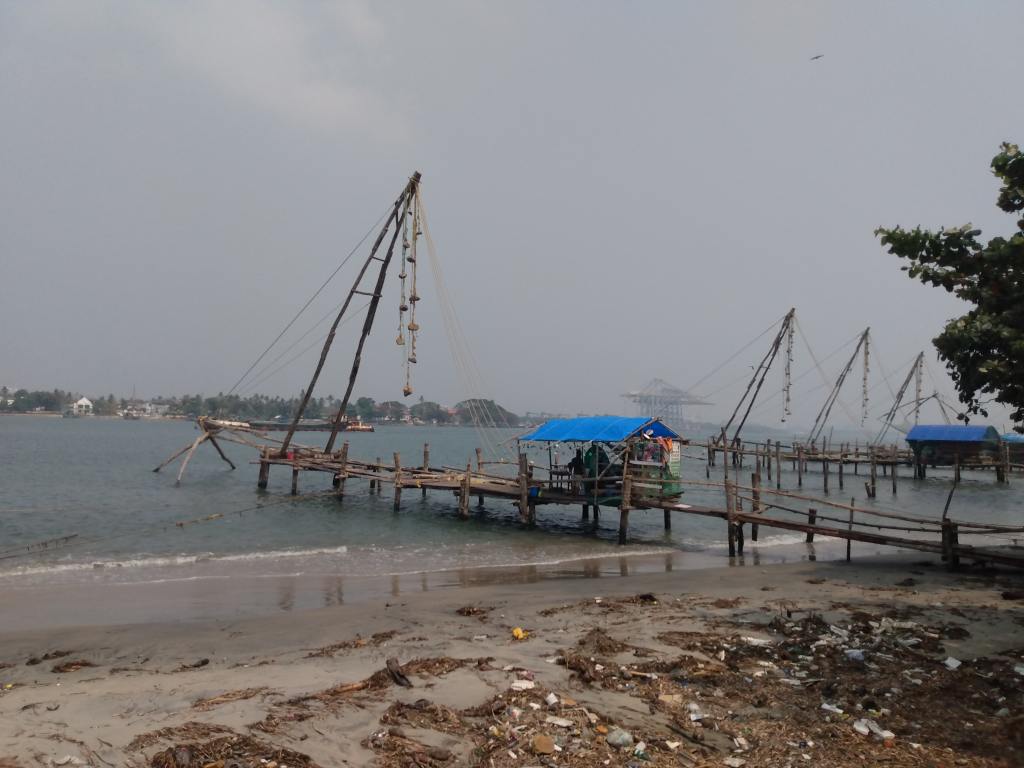
There are many cantilever Chinese fishing nets, which rely on stones to counterweigh the nets and frame. It takes five people to haul up the nets once they have been released to below water level.
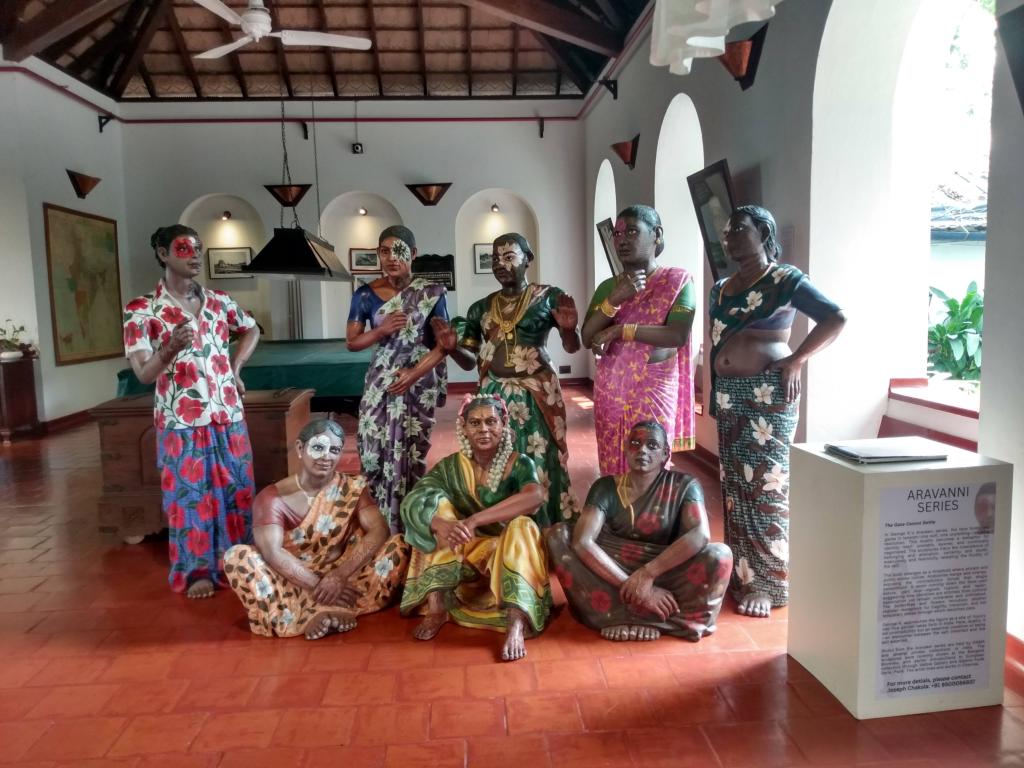
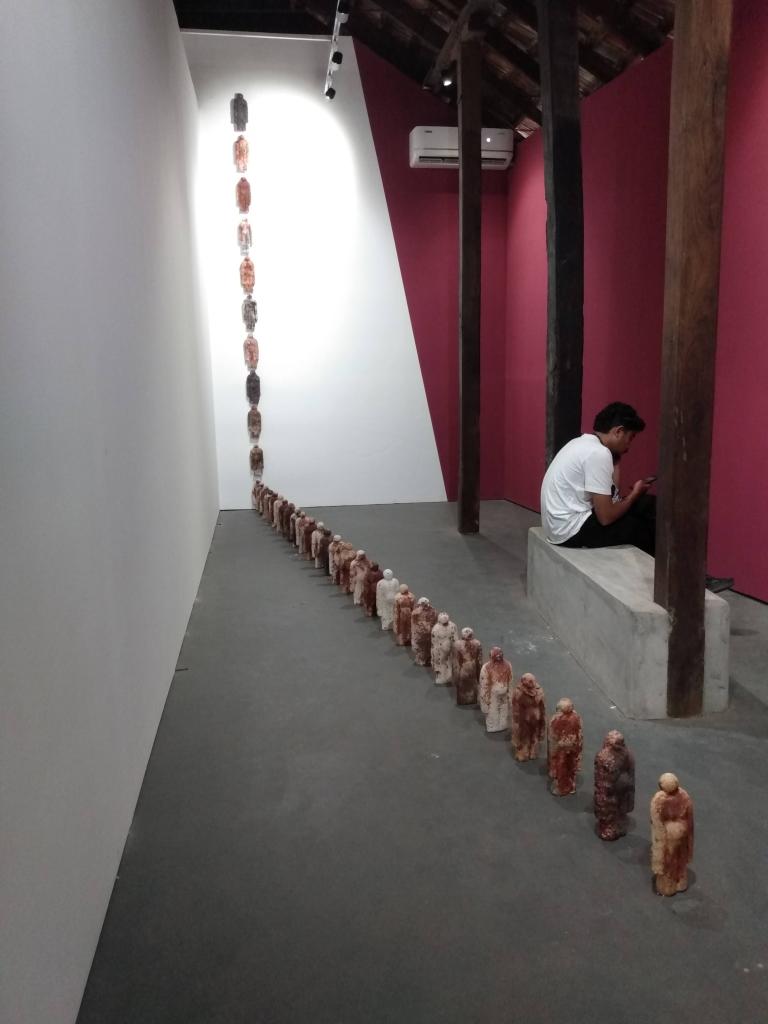
Our second day uses the ‘government ferry service’ into town – yesterday we used the Kochi Metropolitan water transit system (both very good, the latter using electric boats). We spent our energy traipsing around the Kochi Art Biennial entries, with some stunning exhibitions amongst the dross.
We end the night having dinner on a rooftop as a goodbye to both our guide & driver, as tomorrow we take a 6am five hour train journey to Kannur, a six day rest beside the Arabian Sea, before going home.
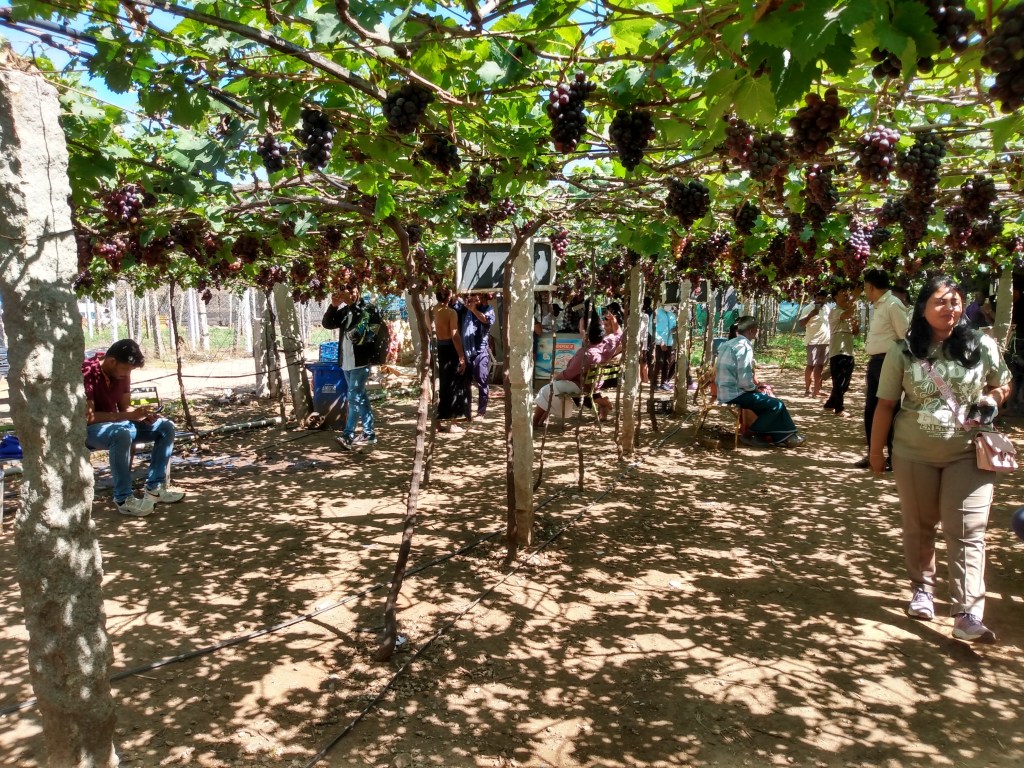
Our journey today takes us out of Tamil Nadu, crossing the border via the Ghatt pass, with spectacular mountain hairpin et al bends, made more dangerous by Indian highway users. But first we stop off at the vineyards, of which we visit Jeni’s. Large crowds swarm into a grape overhead enclosure with security guards stopping anyone picking grapes from the overhead bunches. Then people pay for grape, sugar & water blended juice which tastes …. sweet. And from all of this viniculture, non-alcoholic wine, from all the wine sellers! What’s the point?
Immediately across the border from Tamil Nadu, we are now in Kerala. And in the tourist town of Thekaddy, this means no litter, rubbish, building rubble, torn up pavements, etc etc anywhere on the highways. We feel lighter. We also stop for a coffee and a ‘budgie’ – banana fritter.
Our tour guide has arranged attendance at a Tamil Kathakali performance followed by a martial arts display. Yawn.
Kath then has an hour Ayervedic massage at a famous (like I would know) centre & returns oiled & rested. And the hotel we’re staying in for two nights is rather fine & has beer.
Next day has us walking for three hours with a local guide in the outer zone of the Periyar Wildlife Reserve, hugging the waterline of what is a man-made reservoir, complete with four sizeable pipes serving a hydro-electric power station at the bottom. The lake is in Kerala, the power station in Tamil Nadu, so a collaborative venture. We see all manor of wildlife, including longur monkeys, giant squirrels (with such stunning coloured jackets), a monitor lizard, mynah birds, sambar deer, butterflies with piercing colour schemes and a vivid blue kingfisher.
The afternoon has us on a boat trip around the lake, with more wildlife on display, such as egrets, herons, pelicans, Goar (like buffalos but bigger) and wild boar. The ranger took a photo of a ‘snakebird’ – like a cormorant but with a really long neck.
As this marks the halfway point of our holiday, we take out our guide & driver for dinner & some beers. Transpires our driver, Rakesh, is sleeping in his car & has been doing so for every trip he does, so for a number of years. He’s 42, while our guide, Dominic, is 47, though neither of them look that old. When they’re at home – rarely, as they’ve had two days off in the last 29, apparently – they’re still at their parents’ homes. We had a fun night.
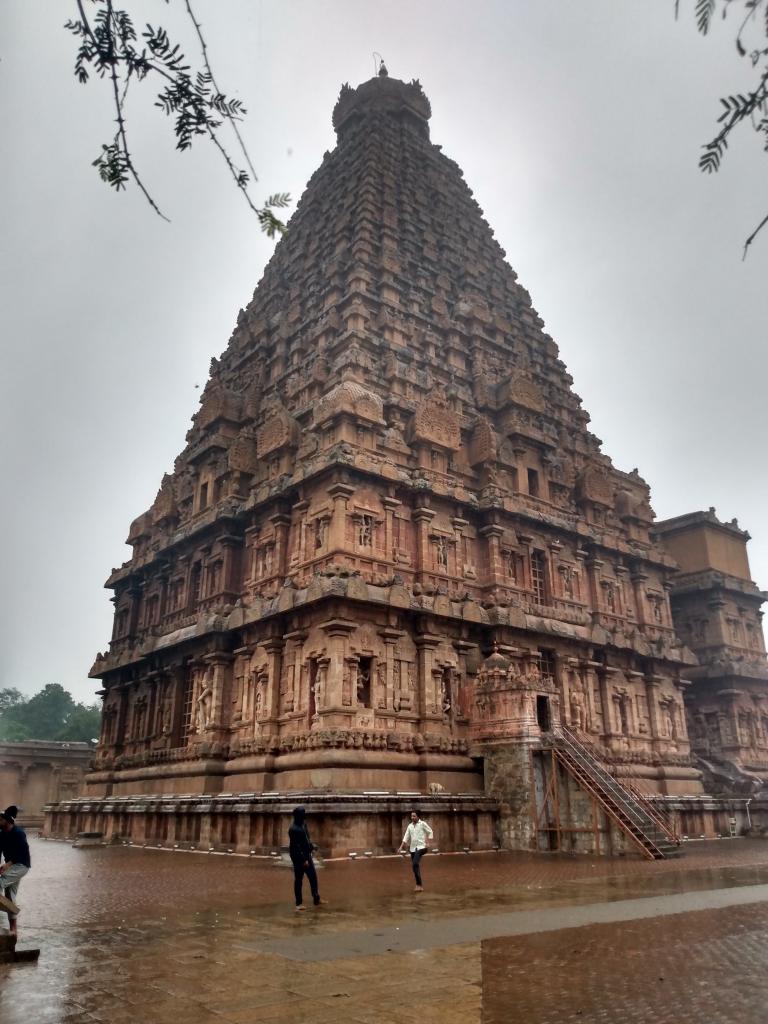
On the way to a one night stay at Thanjavur, we look around one of the UNESCO protected temples dating back to the first century AD. Both this smaller one & the much bigger Brihadisvara Temple are very impressive relics of long bygone Indian dynasties, the highest being 80 meters tall. The former was full of intricate details but not so busy, the latter huge and full of all manner of people, many seemingly on some sort of pilgrimage or Hajj.
The following day we travel to Madurai, stopping off to visit the Rock-Fort temple at Trichy, some 417 steps high. Kath made it though! We arrived in Madurai in the early evening & a guided tour of the huge Meenakshi Temple, much of which was scaffolded for its once every 12 years cleaning & repainting. Dating from the first century, this is a three month job, apparently. And yes, it was raining today, off & on. Still in high 30’s.
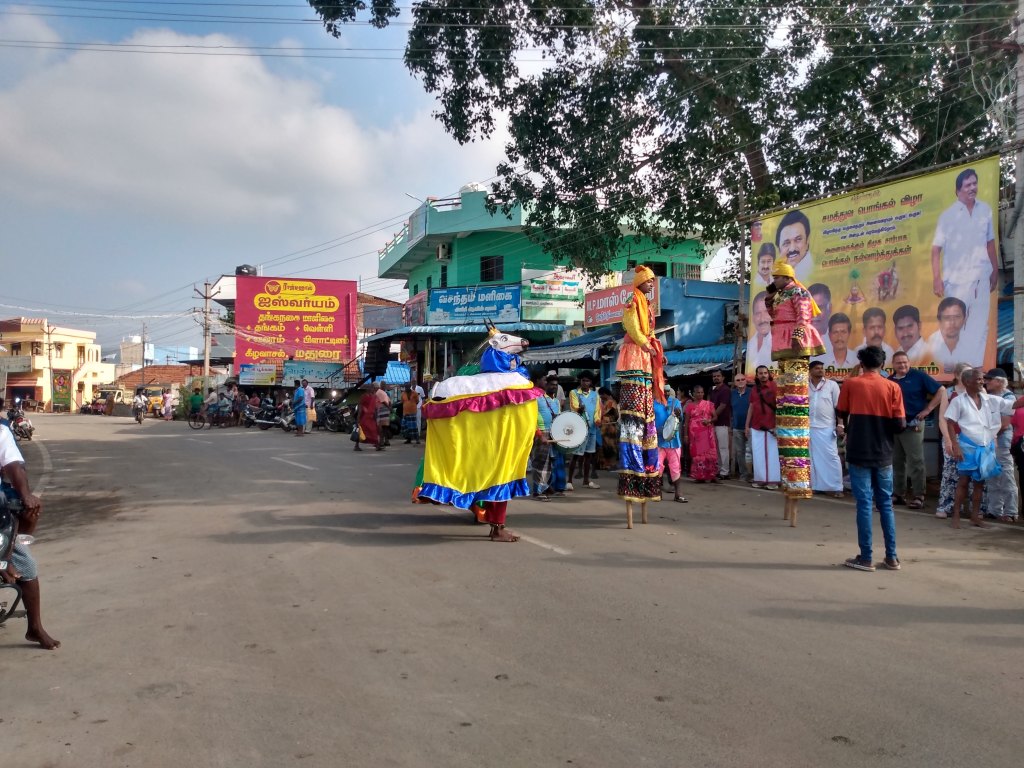
Our second Madurai day sees us leaving at 7am to catch a tourist board bus to the village of Chatrapatti, where we enjoy a procession, including stilt walkers & bulls, to celebrate Pongal. Everywhere people have drawn mandalas with coloured rice powder outside their homes and businesses. This a festival celebrating the harvest of sugar cane, turmeric and rice. The women boiled rice in pots below a canopy of sugar cane and everyone made whooping noise when it boiled over, symbolising abundance and gratitude. Chris thinks that Pongal is actually rice pudding as that is what was dished out to all attendees. A rice pudding festival! The festival was completed with children of various ages dancing to mobile-phone-stored traditional Tamil music & some live drumming. Sweet.
Queues of people waited to be blessed at the temples and appeared with sandalpaste on their foreheads and turmeric on their heads. We also saw families with shaved turmeric’d heads – the hair as a temple offering and the turmeric to prevent infection of cuts! Apparently it’s like sheep shearing with hundreds of people bent down.
Night time was spent at the Gandhi museum – excellent – & the Madurai Government museum – awful. Then an extended walk around the stalls & shops surrounding the Meenakshi Temple – Kath loved this anyway. The stalls were overflowing with the requirements for Pongal including huge mounds of sandalpaste and bowls of vibrant colours.
Pudu (French) or Pondi (Indian) cherry, is the Indian French Riviera, about 160 kms south of Chennai. After being the French HQ in India for centuries, it was handed over to The East India Trading Company before being repatriated to the Indian state in 1954. So half of the city is French built & half Indian. Different from any other Indian city, it oozes charm from a wide range of restaurants, cafes and bars, though our introduction to ‘healthy’ Aloe Vera, ginger & pepper from a street vendor was impossible to swallow – though our driver managed it!
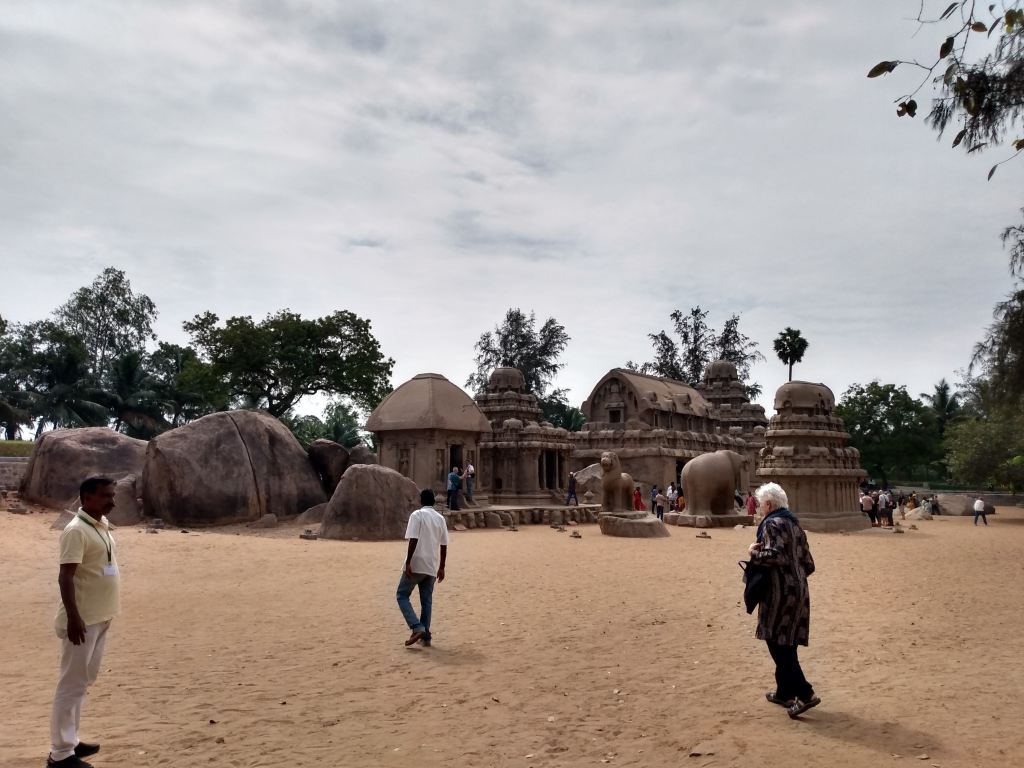
We were staying at the ‘Cours Chabrol’ on the promenade. Unfortunately our view was of the ducting for the building’s noisy air conditioning. Basic but with friendly helpful staff and with breakfast on the roof. Our first day includes a visit on the way. Mahabalipuram’s UNESCO world heritage site includes five temples, each carved from single pieces of granite by artisans of the Pallava dynasty and excavated by the British in the 19th century; another stone phenomenon of a giant ball (Krishna’s butterball) seemingly about to roll downwards crushing all before – it’s been like this for hundreds of years, despite the Brits trying to pull it down using five elephants in the 1940’s; a small fort looking out over the nearby estuary, lake & ocean; and another ancient stone temple which survived the 2004 tsunami while all about it was flattened. Special place heh? And now it’s overrun by tourism.
Our first night in Pondi doesn’t include much food as our guide & driver took us to a transport café type restaurant just after 3pm to be met with mounds of food, with equally remarkable prices. Instead we visited a live concert in the French Arts complex, featuring a very talented French guitarist/singer, Geoffrey Grenier, accompanied by a tabla player. Imagine sung versions of The Doors, Cream et al & you’re there. But he managed to pull it off – we even stayed for the whole one hour set. We then tuk-tuk’d to the Catamaran craft brewery, yep – craft brewery, where we were almost bowled over by how good the beer was & how busy they were. And how uninhibited alcohol-inspired locals’ copy Bollywood dancing could be!
Our second Pondi day started with a visit to Auroville, a settlement developed by Mirra Alfassa, aka The Mother, in the 1950s to provide an international base for spiritual personal learning & collaboration. The complex features a futuristic globe, the Matrimandir, for contemplation. It looks like it might have been on the set of The Prisoner.
Next was a visit in the town centre to the ashram of Sri Aurobindo, developed from about 1910. This place is famous, so I was informed, & we even spent 20 minutes there with our guide who seemed to take it a lot more seriously than we did. He also stayed in the Roman Catholic church, for their service, after we had all visited various exhibitions & outside galleries. We, meanwhile moved on, ending up in The Spot restaurant built out of a former colonial residence, complete with courtyard. A fine meal & various beverages later, the world seemed less pressured.
We have two days before our driver, Rakesh, who collected us from the airport, & tour guide take over, so we are artless & fancy free.
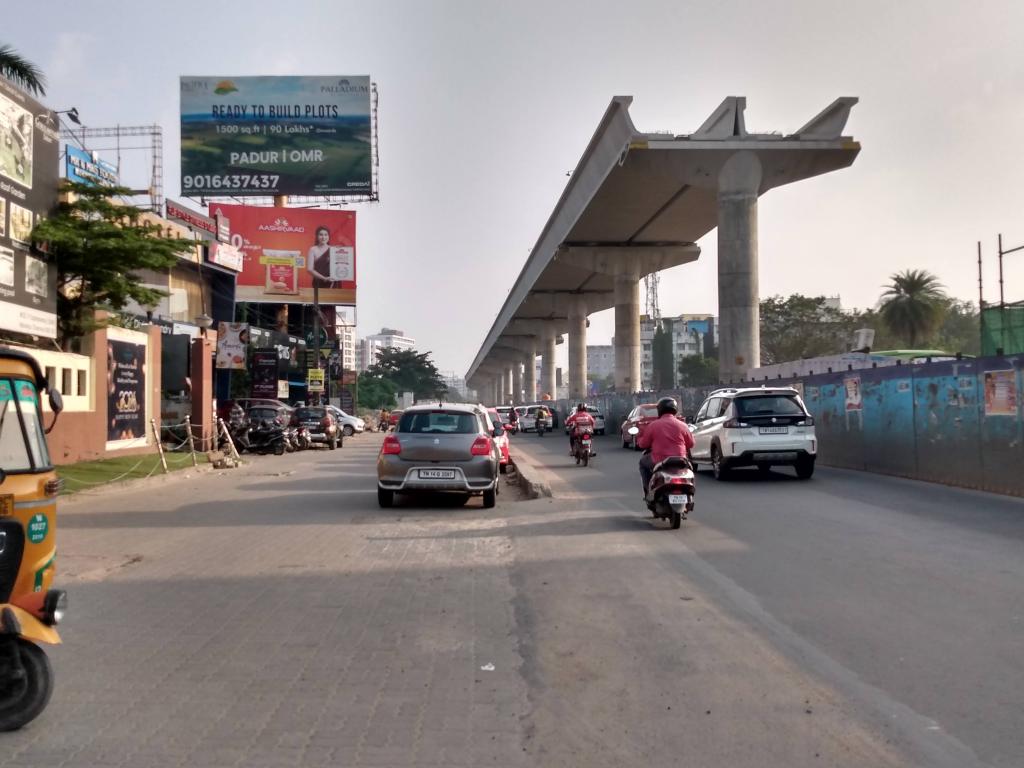
The huge, dense, ever bustling city of Chennai has recalled all our previous Indian holiday experience. Perhaps foremost is the traffic – chaotic use of both sides of dual carriageways with an informal extra double carriageway aside each formal road; think three dual carriageways with direction of channel unknown. And the traffic comprises lorries, vans, buses, cars, tuk-tuks &, of course, assorted cows, goats & dogs.
Our hotel, one of the local Gokulam Park chain, must have been really smart in the 70s/80s. That might have been the last time serious money was thrown at it, now a tired once grand hotel, with not enough guests & unengaged staff. Yawn probably sums it up, but Kath & I have a soft spot for these mausoleums.
Significant construction of concrete pillars & bridges indicates a new public rail transport is coming.
Just need to convince all those road users then to relinquish their fave vehicle. Meanwhile, the traffic chaos is excruciated by all these on-road building sites. Ended the day with a fantastic curry. Of course!
On our second free day, we walk. And walk and walk, almost 10 km, eventually taking a tuk-tuk to the beach. The ocean here, part of The Bay of Bengal, is angry and dirty. Apparently murderous, too. So we didn’t go swimming. We found another dark bar in another hotel’s dark corner – it seems they want the income yet pretend they’re all good Muslims – before taking another tuk-tuk back to our hotel. Very tired. Tonight’s curry was at an Andhra-style “palace” & also really good ( Carrot 65 unexpectedly violently hot!). Yet to have a bad meal …
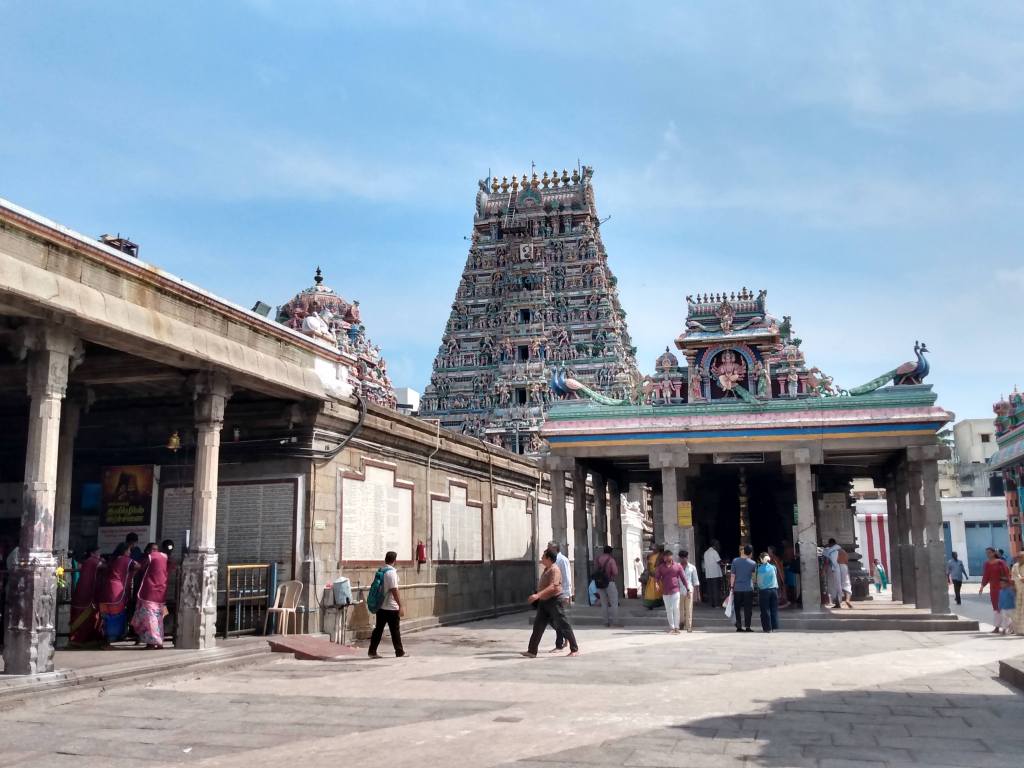
Day three begins with our newly connected tour guide, Dominic, & reunited with our driver, Rakesh, we start our fearless 4 tour. First off is the Kapaleeshwarar Temple, an astounding series of brightly painted human & not human creations, telling the stories of the gods, built into an ever rising archway, aka Dravidian (historically local) architecture.
The creations were astonishing &, like all temples, without shoes. Our guide even managed to inveigle a smile in a photo from Chris. Not be doing that again.
This was followed up with a visit to St Thomas’ Mount, the first arrival of Doubting Thomas in India, where he apparently made good after departure from the last supper stuff. Probably caught the duff location from dividing up the world between the apostles to sell christianity. Looked around his recently made Basilica status church & a museum dedicated to Thomas, who was murdered by a local gentry-type fellow by being speared in the back. From the museum we learned that only Paul survived more than a decade after the last supper & that was despite being boiled. That’s resilience.
An early evening visit then to Marina Beach, second only in size to Rio’s mighty Copacobama / Ipinima, apparently. This beach is huge, both depth & length, indeed some of the food etc stalls look incapable of being moved; and, like the roads, all car parks are bloated with buses, cars, tuk-tuks & motorbikes/scooters.
And then our first poor meal, at our hotel, where a stunning menu in front of us turns out not to be the “new menu”, which is yet to be published for the customers. Need we say more? Another sign of this hotel’s fall from grace.
Our last day in Chennai sees us stuck in lengthy traffic jams to reach St Mary’s Church, a Scottish Presbyterian copy of London’s St Martin on the Field, built on marshland using piled foundations. Daring for late 19th C, but also unadventurous once the foundations had been laid.
We were also, reluctantly, taken to visit the “Birdman of Chennai” who, along with other members of his family, is renowned for feeding thousands of wild parakeets daily on their terrace in Chintadripet. Interesting if you’ve never seen a parakeet!
Our explorations of Chennai ended with a trip to the huge main market – as in fruit, flowers, vegetables – set in dowdy galleries which nonetheless do the job after 200+ years. And frequented also by cows, goats, dogs. And our last dinner is made of momos, from street food traders, which are delicious & just the right amount of food.
Another visit to India beckons, this time in January 2026 to the south. On 5th we fly with Gulf Air to Chennai (formerly Madras), via Bahrain. But the beginning of our trip starts ominously: due to engineering works at Swindon, the Swansea to Paddington train has to travel via Bristol Temple Meads & Bath, thereby adding an hour to the journey.
Except it doesn’t, the train stopping about 30 mins short of Reading due to faulty track things & then returning to Bath & Bristol. So we have to go from Bath to Salisbury, thence to Paddington. The journey to Max’s taking 10.5 hours means a small family Xmas doesn’t happen. The following day’s matinee performance of A Christmas Tale at The Old Vic was great, however, so not all was lost.
We catch the 9.30 flight to Bahrain, then on to Chennai, arriving at 23.30, local time 6.00. Our tour driver, Rakesh, introduces himself at the barrier. All good. It takes an hour to get his car out of the, huge metropolis-like, airport. Then he drives us to our hotel, but no, not our hotel, another in the group so we have another journey to make. We enter our room for the next four nights at 9.00 local time – a long day. So we had some breakfast!
A five hour journey in two trains, the first uncomfortably standing throughout, brought us to Waikkal. Here, for our last two Lanka nights, we’re staying in a jungle chalets complex, right by the Gin (pronounced yin) Oya river. On the station platform at Hikkaduwa, we bumped into Anne Browne (Plantag), travelling with her friend Linda around the island.
Our chalet has a bathroom open to the skies & insects of all manner & sizes – cockroaches, beetles, frogs & mantis. We’re in the jungle, yet within earshot of trains & airplanes landing / taking off from the island’s Bandaranaika International Airport. A small chunk of jungle, then.
The complex has two cows plus one junior, a ‘rescue’ called Elodi; they are friendly and roam wherever, incl. to your table in the restaurant, yet no sign of steaming cow pats. Domesticated or what!
Went to the beach & loved the not-so-high waves. Very few people there but many in the series of resort complexes just inland of the beach. On our return, both the manager & the chef warned us of the dangerous sea along Kammala beach; only last month three people drowned, with two trying to rescue the one that was dragged out by a wave. Kaff doesn’t want to go there today (our last in Sri Lanka).
This safari-styled hotel was sold last December. The manager & chef were brought in by the new owners, all the other staff being retained. Have had long conversations with two former and a brief one with the new owner, who appeared yesterday. He informed us he has bought a hotel for each of his two children – they’re 15 & 10. We explained it might not work out quite like that!
Some final thoughts:-
Fire – Lankans like making fire, little fires, border fires, bush fires, brush fires, even a fire in a frying pan. Any excuse, they’ll light up.
Tea – we was misinformed, tea leaves are picked every 7 to 10 days, not years! Agh! The tea pickers are nearly all Tamils, who were imported by Thomas Lipton & other plantation owners from India because the locals didn’t want such hard jobs. Remind you of more recent immigration in western Europe? The picking is eight hours a day for, we were informed, pitifully low wages. The workers mostly live just outside the plantations in what can best be described as shacks. Meanwhile, both the manager & the deputy manager are given houses inside the plantations. No further comment.
We’re due to fly out at 02.55 tomorrow morning. After a three and a half hour stopover in Kuwait airport, we should land at Heathrow at about 13.45. That’s a long day already. The time differential is five and a half hours.


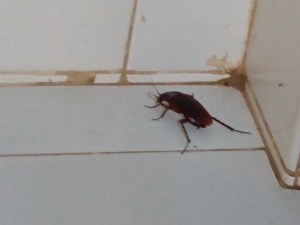 Our chalet has a bathroom open to the skies & insects of all manner & sizes – cockroaches, beetles, frogs & mantis. We’re in the jungle, yet within earshot of trains & airplanes landing / taking off from the island’s Bandaranaika International Airport. A small chunk of jungle, then.
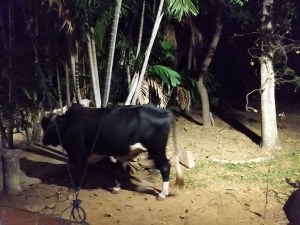 The complex has two cows plus one junior, a ‘rescue’ called Elodi; they are friendly and roam wherever, incl. to your table in the restaurant, yet no sign of steaming cow pats. Domesticated or what!
 Chris & Kath's Travel Time